Search results
255 results found.

On The Edge of the Edge – The U.S. – Mexico Border
255 results found.
There are 100 billion neurons, connected by synapses in your brain.
The entirety of those connections make up the “connectome,” which many scientists think are the key to human identities.
Who knew?
One might ask, what if one of these neurons was changed/altered, would we be who we are now? Ten? A million? Would I be funnier if a mad Mega Scientist changed 107 of mine? Would everyone be nicer if 12,300 were altered in every baby? A world of nice nice. Would you want it?
What about not nice not nice? A world full of Don Rickles’?*
And, could all the IT Transhumanists do the changing? And what could they turn us into, should they acquire the skill to do so?
Why is this on the Border-Blog?
I dunno, the “border” has become kind of a bore. This isn’t!
Enjoy your day.

What’s next and who do you want to be?
Illustration: Cleveland Clinic
For almost twenty years photography has been my voice and the border has never stopped callin’ me.
Photography moves me still, but in conversation, more and more I’ve talkedf about my teaching job at New Mexico State University, as “passing the torch.”
I’m not sure, but maybe it’s been passed (and will continue to be).
I’ve been fretting fora few years about “what’s next?”
Right now, all I know is, if you aren’t feeling as good as these kids (on this video) or even something a little like it, it’s time to stop fretting and get the “next” going.
And I shall.
Two things are calling me and calling me hard these days and nights: Music (guitar… which doesn’t let me go to bed early or even late) and Africa ()which just won’t get out of my head).
Stay tuned, when Im know more I’ll let you know.
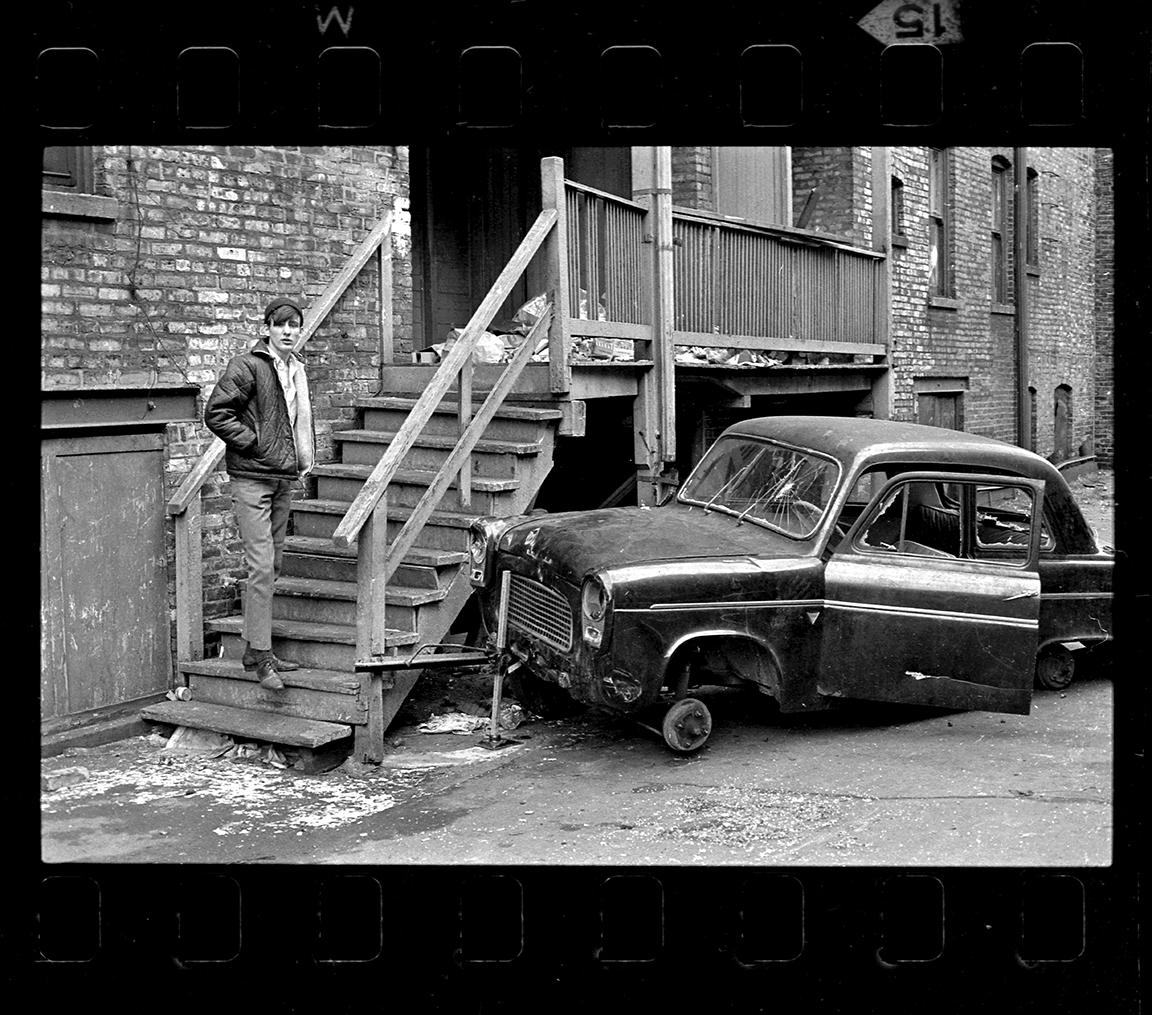
Photograph and text by Bruce Berman
Autumn 1971.
Eddie Geary got a new/old car.
He was scrounging the ‘hood looking for tires and rims. Not sure it ever got running.
I knew him for two years and the car never moved. The neighborhood never changed (until years later and the gentry came in, upped the equity and got rid of the Eddie Gearys).
Don’t know whatever happened to Eddie. Did he go back to Kentucky? Did he get up and out of the ghetto? Did he get a car of his dreams?
Don’t know. Wish I knew.
The photo series Uptown was more specifically about Appalachian migrants to Chiocago from Kentucky and Tennessee. It was my first documentary project. I wasn’t as good as the subject was, but I go my start. I just finished a book that contain the images. I’m lkooking for a publisher. It’as called the ChiTown Journal. Itr was my first “border ” project.
The border I refer to wasn’t a physical line but, actually, the line between immigrants to a foreign land and how their otherness, their language difference marginalizes them, leaves them open to exploitation and and makes them vulnerable to a social and lkegal system that does not favor them.
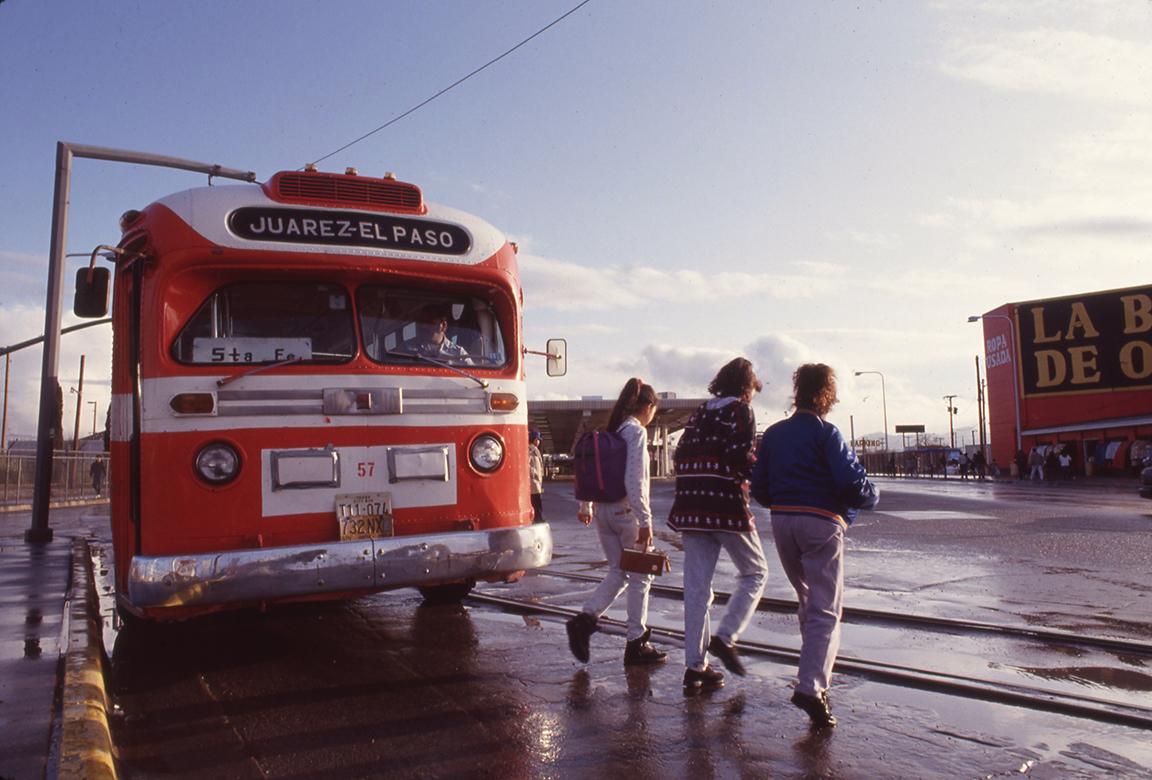
The Red Bus, Paso del Norte International Bridge, El Paso/Juárez, 1989
Photograph and Text by Bruce Berman
The Old Red Bus ran back and forth over the Juárez International bridge for decades. The bus itself was from the late 1950s, a GM. First photo I ever took when I got to El Paso and started wandering around was of the Red Bus, on El Paso Street. I noticed the women, from 18 to late 40s, lined up. I came to know that they were “maids,” low wage women from Juárez that came over every day and served the Anglos of a neighborhood north of downtown. It was called Kern Place. At the end of the day -those that worked by the day and not the week- would walk south down the hill to “EL Centro,” get on the bus and go home, to Juárez
Generations of Anglo kids were raised by these “maids.” Tons of dishes were washed. Beds were made. Laundry was done. They watched the American culture and went home. Key word: Home. Theirs. Another world.
I shot that old photo in October 1975.
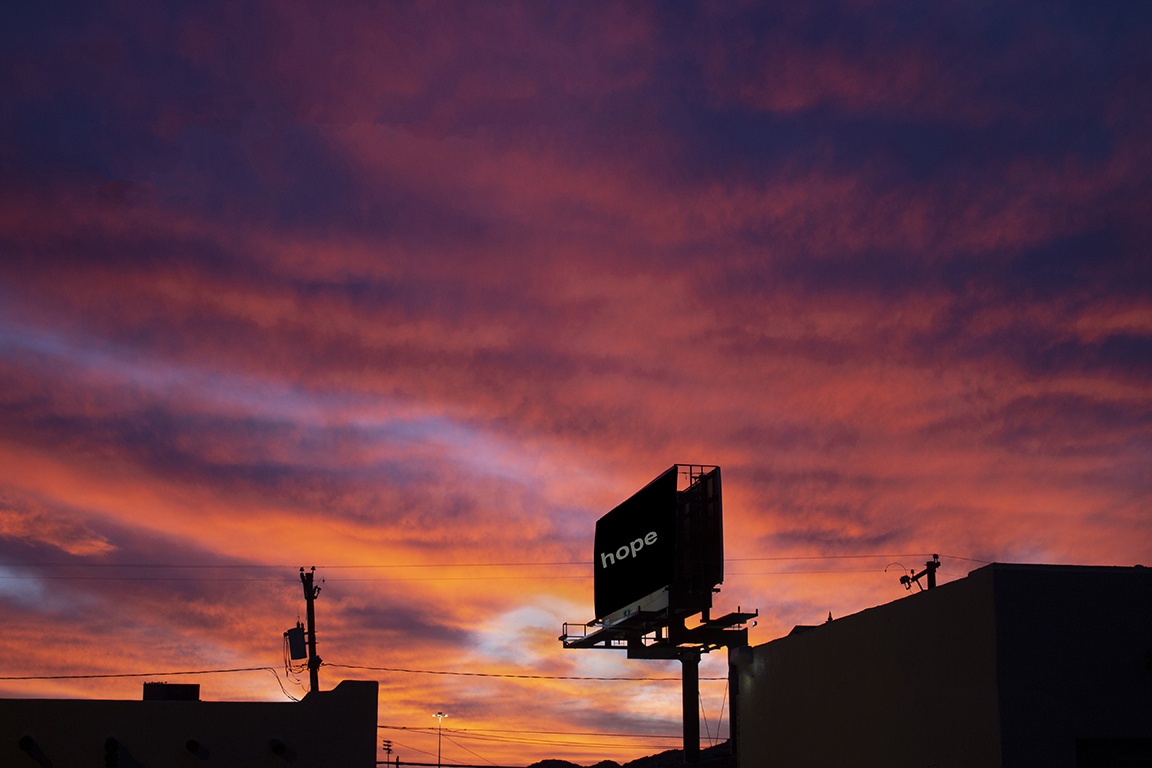
Hope on the border (Illustration), El Paso-Juárez, 2021
Text/Photography by Bruce Berman
This is not a photograph. It is an “illustration.” It’s a “montage,” a form of photography that goes all the way back to the near beginnings of photography. The distinction between “illustration,” and “photograph,” is that the former is an idea and an opinion and the latter exploits photography’s main strength: believability.
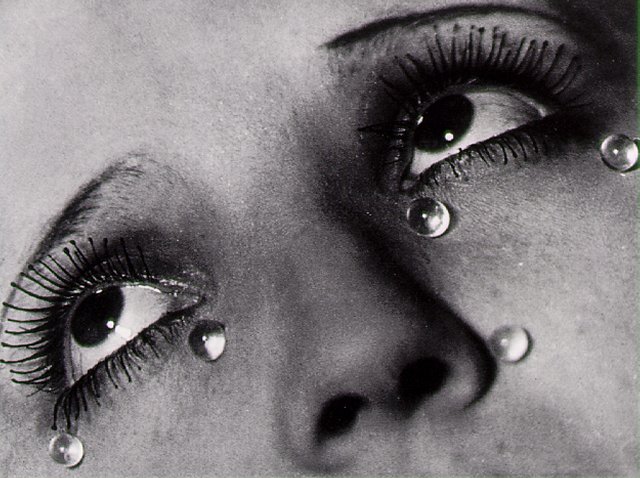
Tear drops by ©Man Ray, 1930
Text by Bruce Berman
Dear Border-Blog reader/viewer.
You will notice there is a three and a half year gap from March 18, 2016 to October 12, 2020.
I have not been lazy. Frustrated? Yes. Bummed? At times. Optimistic? Of course.
Last August we had a malware attack. I maintain and post on five different websites, this one being the grandaddy of them all. Each had to be shut down, suspended and pronto! The entire host’s hard drives would be infected if the site stayed up.
So, we shut it down.
I’ve missed it a lot.
THIS SITE HAS BEEN DOWN FOR TWO MONTHS. WE’RE BACK. THE SITE WAS SUSPENDED AND IT TOOK THIS LONG TO RESTORE IT TO TOTAL BUG-FREE HEALTH. TO BE HONEST THERE HAS BEEN VERY LITTLE “ME.” THE BORDER BLOG WEBMASTER, MANNY RIVERA, FOUGHT THE MALWARE FORCES OF EVIL… AND AS HE ALWAYS DOES, BROUGHT US BACK TO LIFE.
SO GLAD WE’RE HERE. SO GLAD YOU’RE HERE.
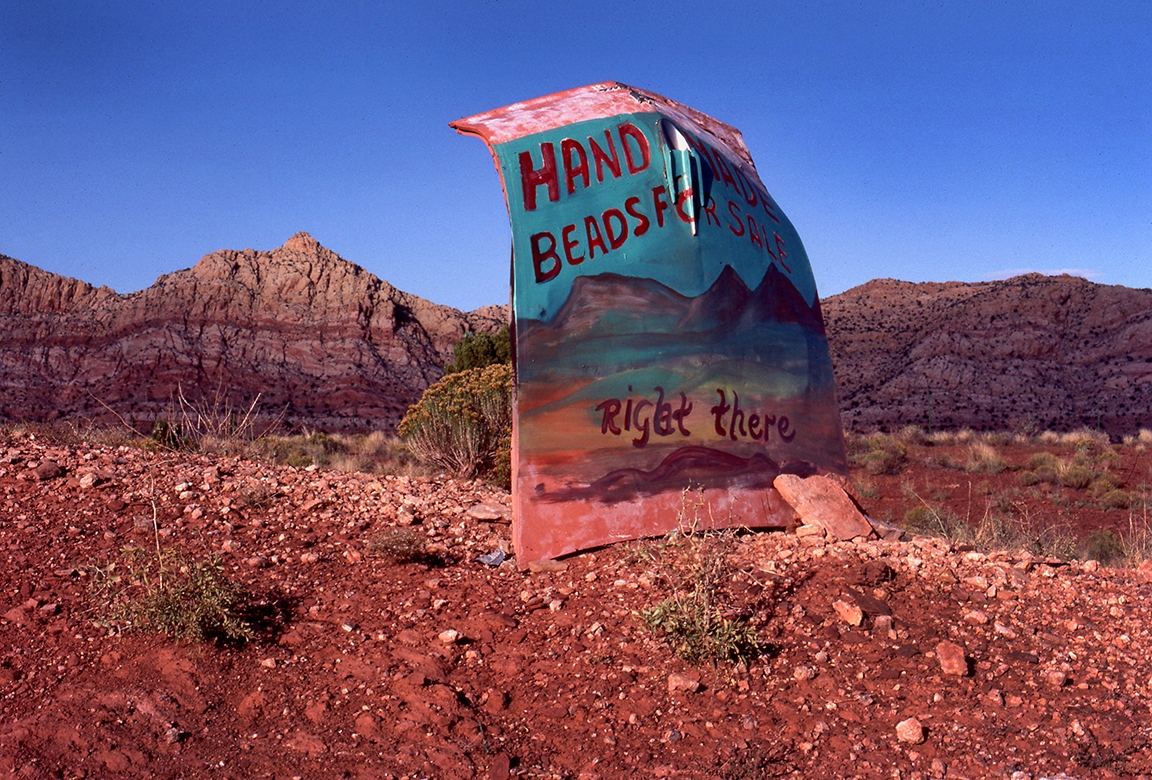
1951 Ford hood, Navajo Reservation, Utah, 1974
So here we are, searching for borders again. It’s been a long time since I began this photo journey in 1968. First there was the “border” of Appalachians in Chicago.
Then there was the Five Nations of Oklahoma and the last refuge of the Buffalo in southwest Oklahoma.
Eventually I found my way to El Paso/Juárez. That one’s took thirty-five years plus.
And now?
Not sure. Usually I have wandered into my “forward.” Been stuck lately, taking care of business, being a professor, thinking, living in the old paradigm.
I suspect it’ll be that way again. I’ll bumble into the “next.”
I just mentioned -above- all the stuff that’s in the rearview mirror.
Looking out, over the hood… well you have to get the car into first gear first.
It’s coming.
Stay tuned. The Border Blog is back.
So am I.
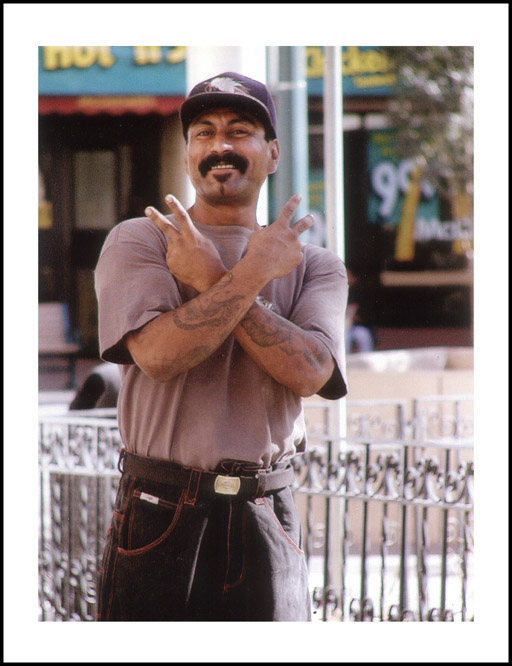
El Paso’s Central Plaza, is officially named San Jacinto Plaza. It is located in the middle of El Paso’s original business district and about 3/4 of a mile from the border with Ciudad Juárez, Mexico. In recent times its unofficially been called Plaza de los Lagartos which refers to the old pool in the middle of the plaza that used to be the home of alligators (lagartos in español) which no longer existed after the early 1970s. The alligators were later commemorated, in 2006, by a fiberglass sculpture of alligators by native son and internationally renowned artist, Luis Jimenez.
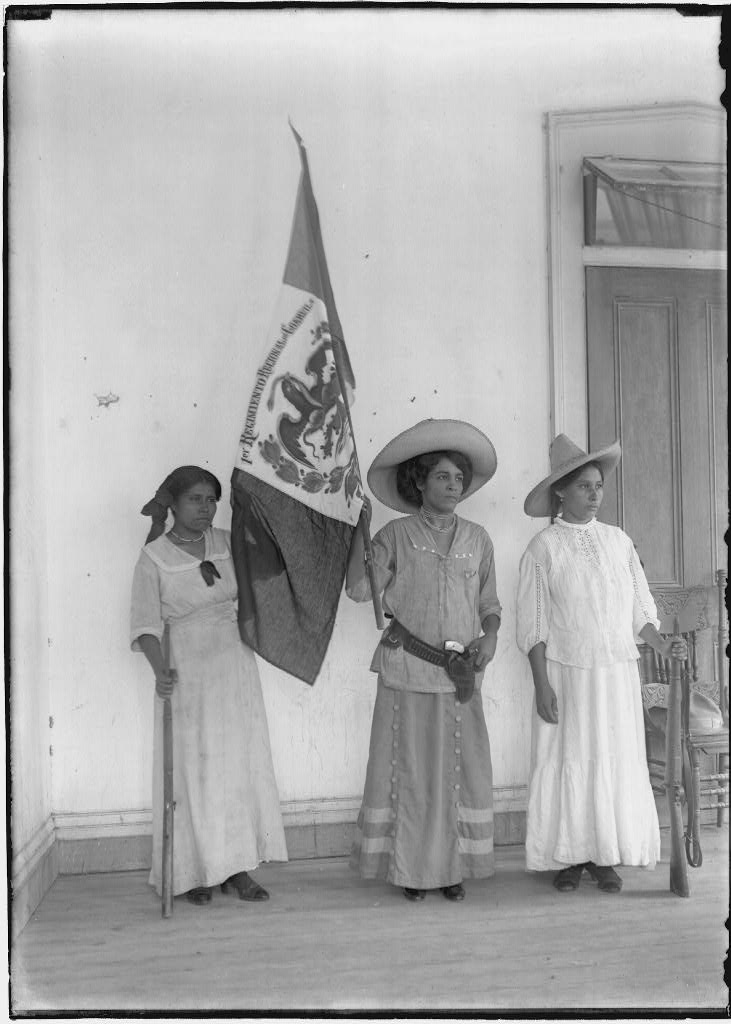
This photograph was taken during the Mexican Revolution (1910-1920), exact date unkown.The photograph was taken by commercial photographer Robert Runyon (1881-1968), a longtime resident of South Texas. His photographs document the history and development of South Texas and the border, including the Mexican Revolution, the U.S. military presence at Fort Brown and along the border prior to and during World War I, and the growth and development of the Rio Grande Valley.
This image was shot on a glass-plate negative ; 5×7 in. Camera unknown.
Text and Photo by Bruce Berman
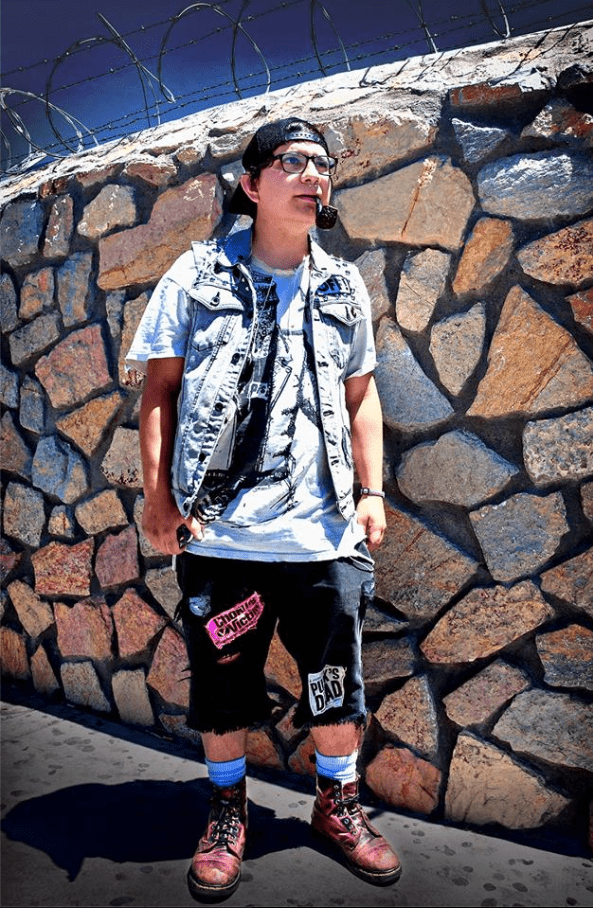
No telling what and who will come over the Cordoba bridge that links El Paso, Texas with its sister city Juárez, Chihuahua.
In this case, crossing from south to north, was Spencer.
Pipe, a hat that said “F___ Off,” aged Doc Marten’s, punk rock labels every where, he is as ecclectic as the border. In a strange way he, is the border: neither this or that, neither Mexican or American, neither barrier nor passageway.
A friend once called the border a metaphor for a person who has “an undefined personality.”
Looking at Spencer -and some others (in my mirror!)- I’m thinking it’s a place for very defined personalities.
The problem is that it’s really difficult to say exactly what they are.
Which brings us back to “undefined.”
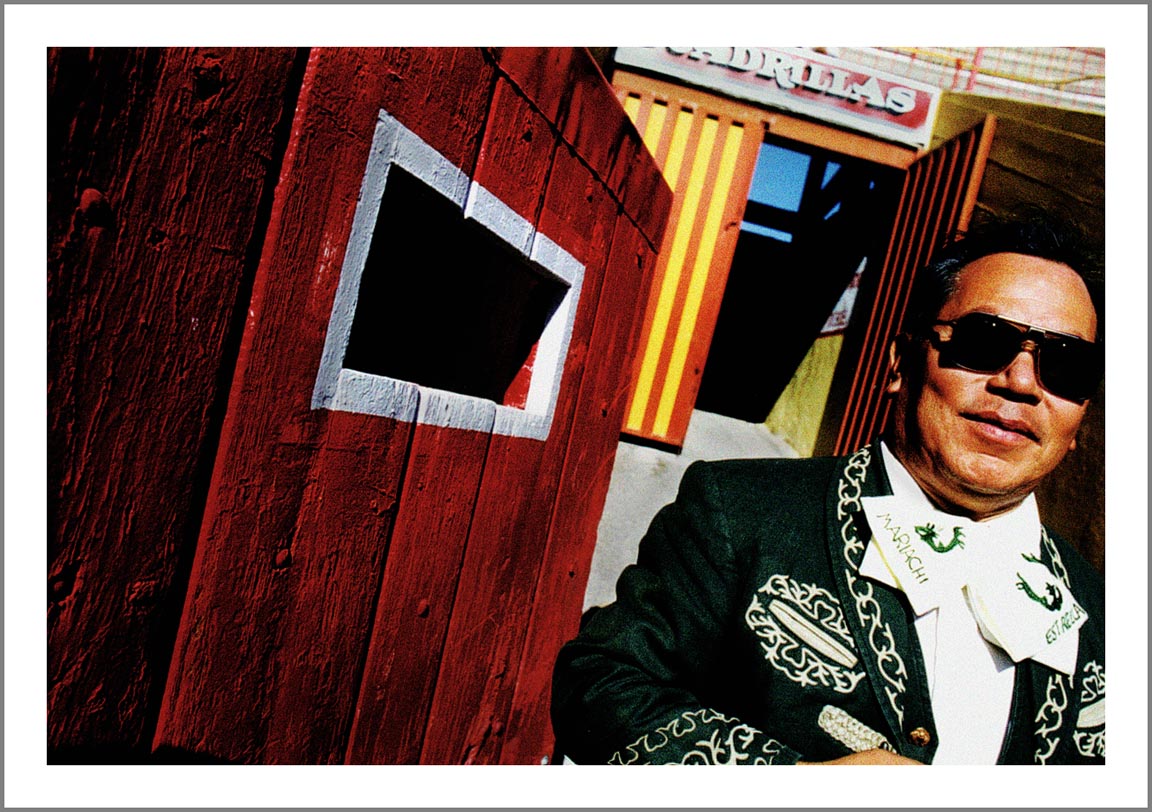
Mariachi, Juárez, 2002
There was a day when you could think of Juarez and think in color. I get whiffs of it lately, but one is so cognizant that under that shiny surface is a black and white heart that has been ripped open for all to see and it will take a long time fill with the energy and joy that was -and will be again- the hallmark of Ciudad Juarez. It will happen. It is happening now. A generation has now come that learned to live abajo, and carefully. There has been damage. No one can live under that cloud forever.
It’s nice to look back, now and again. But here, on the border, it has been years since people have allowed themselves to look forward.
There are “whiffs.”
\
Commentary by the Editor
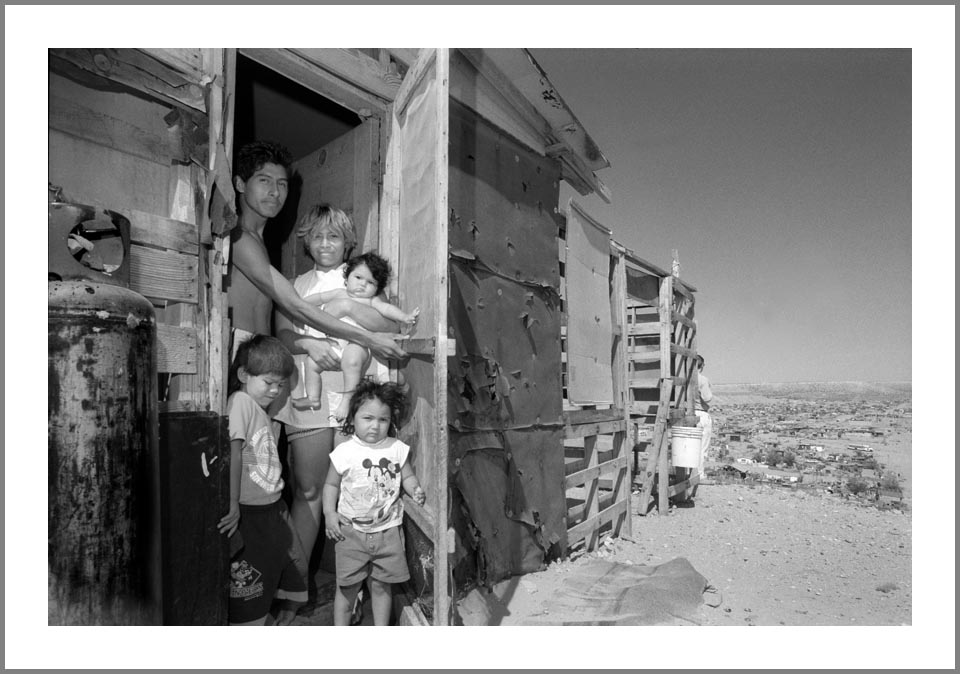
Juarez, Chih., Mex. — So how did this Cartel War begin and how does it end?
The Border Blog will not answer that today. We look for the things that make the heart tick and leave the fancy thinking to those that make these messes in the first place.
Roughly, for me, it began a long time ago, when the people who have most of the marbles understood that they didn’t have to do a thing about bringing along another class of people who had hardly any marbles at all. Impunity. No apologies. In Juarez the maquila industry began when someone figured out that Labor was a cheap product that Mexico had a lot of and that it could be exchanged for some major profit. Of course nothing so crass as that was said. Rather, this was the bright new day that would lead to a burgeoning “middle class,” and bring everyone up from the bottom. So they said. So the “development” of Juarez began. The powers that be brought willing companies looking for labor and they delivered “labor.” This labor, also known as the citizens of Mexico came from the far flung corners of Mexico. They had nothing else to do and would work at any price, went the theory. Everyone would be happy. You move here, we’ll give you subsistence (and societal dislocation), and we’ll go to the bank. Everyone will be happy.
Right?
When I first started photographing in the maquila factories of Juarez in the early 1980’s the salary in a maquila was $5 per day. Today it’s a little over $7. A full two dollar increase in 20 years. Imagine!
It wasn’t sustainable then and it isn’t now.
The promise of some kind of job, of rising above downright depraved poverty, was strong and people flocked to the border factories. First from Veracruz, then from Durango, then from Torreon and on and on.
If you were a Mexicano and wanted to improve your life without the terrible alternative of actually crossing the border and trying to make it work in El Norte, you headed to the maquilas of Juarez or Tijuana or Nuevo Laredo. If you made that journey you left your culture and customs behind. This was the brave new world.
Bienvenidos campesinos.
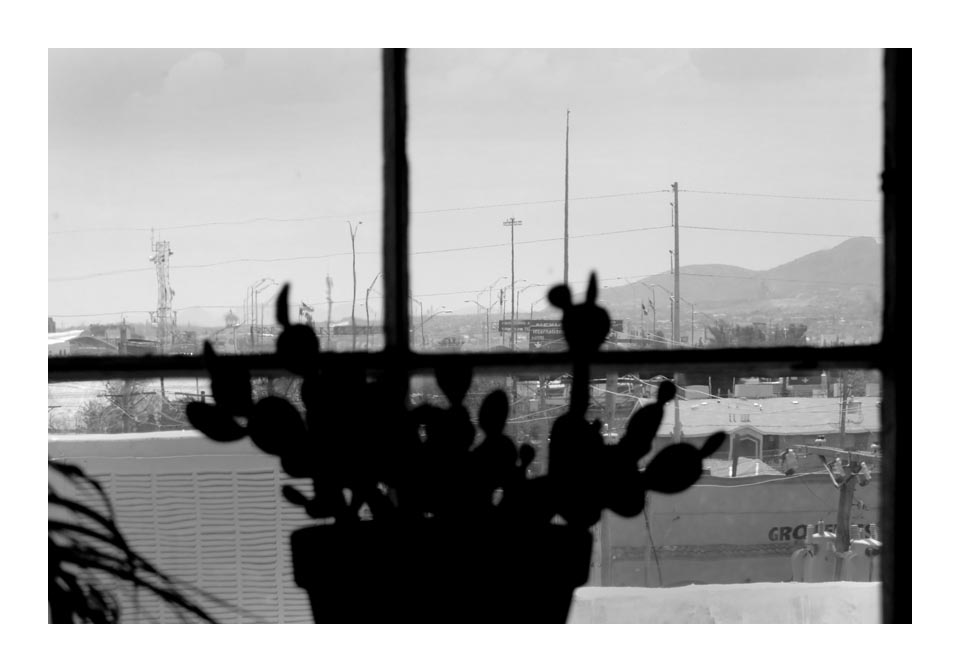
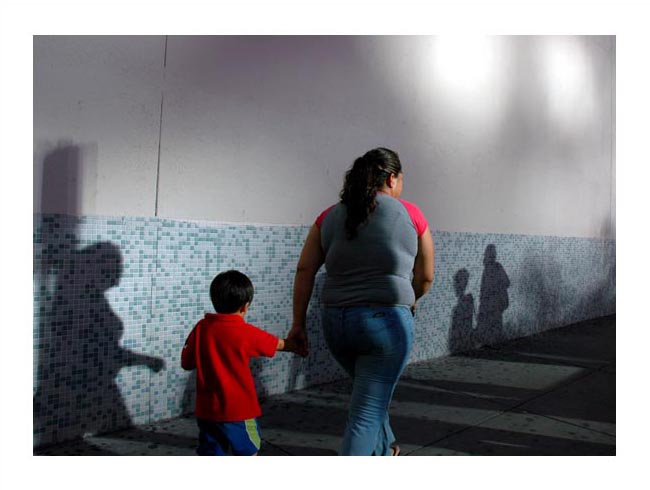
Flags are down in Parque Chamizal. Wind must be up and hopefully a little rain. Just a whisper of a season change. Not yet. But not all that far off either. ‘ta bien. The View South. Days come and go. Then years. Then decades. Then…? I turned my back on the past a long time ago. People tell me that’s good. Bible says it too. Do they really mean it?
Opinion/Observation
by Co-Editor Bruce Berman
___________________
I drive my old routes. Camera on the passenger seat or my lap. As always, these days it usually stays there, untouched. There are things along the way that spark memories. Object that aren’t there anymore. Gorgeous commercial signs constructed by craftsmen in the 1950s and 60s (not the least of which from the Jimenez Sign Company) were carted off to other cities that were twenty years ahead of El Paso in their bourgeoisie ambitions.You can drink under some of El Paso’s “Motel, Vacancies,” signs in various bars from Austin to Houston to Baton Rouge. There’s a withering away now, aging and weathered, but mostly not endearing anymore, not worth stopping for (to make images). There came a year, a month, a day when the treasures of El Paso were either gone, carted off or just left to rot.
There are whole swaths of this incredible and authentic city that are gone, at least for the long gaze of a photograph: Alameda. El Centro (downtown). Segundo is shrinking fast, bordered by El Paso Street on the west (with nasty tentacles of them all over it) and Cotton on the far east, with old residents living out their days, youth getting out fast and them with their bulging eyes all over it. Off of Delta there are condominiums and some revamped industrial buildings, residents living an almost urban lifestyle (sans humanity). Even the Gay Bars have fled, a sure sign of urban renewal/removal.
It’s not my job to do anything about any of this. My job, as I saw it, at the beginning, in 1980, was to give face to a face that was not known and I have tried. As The Grid lays out its future in the city with two hearts, it’s clear to me that my mission isn’t to pick sides in land rights, power exchanges, or to watch -or judge- the inevitable blandification. But blandification has come. Oh happy day. Some loudly exhale and go, finally! The city is becoming presentable to visitors again. It’s cleaner. It’s newer. There’s baseball. Soccer is coming (watch out Chamizal! The final blow that started in the mid 1960s is finally here). There are restaurants with the preface Le with Foo Fo thing-a-ma-jig dishes with little portions of things that look like they squiggle -vegetables- on top of things it’d be hard to identify below. Fancy. Plates of Foo Foo. There are young people downtown again, well, the kind of young people that look like they’d also be comfortable up in Kern Place on Cincinnati and the upper Westside.
Finally, there’s a Starbucks downtown near the Plaza and the Westin. The kids from the ‘hood can serve the hipsters that come in from outer Zaragosa Road and beyond.
Boring? Not to everyone and I wish them the best. I am not part of this. I left this scene in three other places I lived before this very long stretch here. It’s the same message: you’re in the gentry or you’re equitied out of the gentry.
CORRECTION:
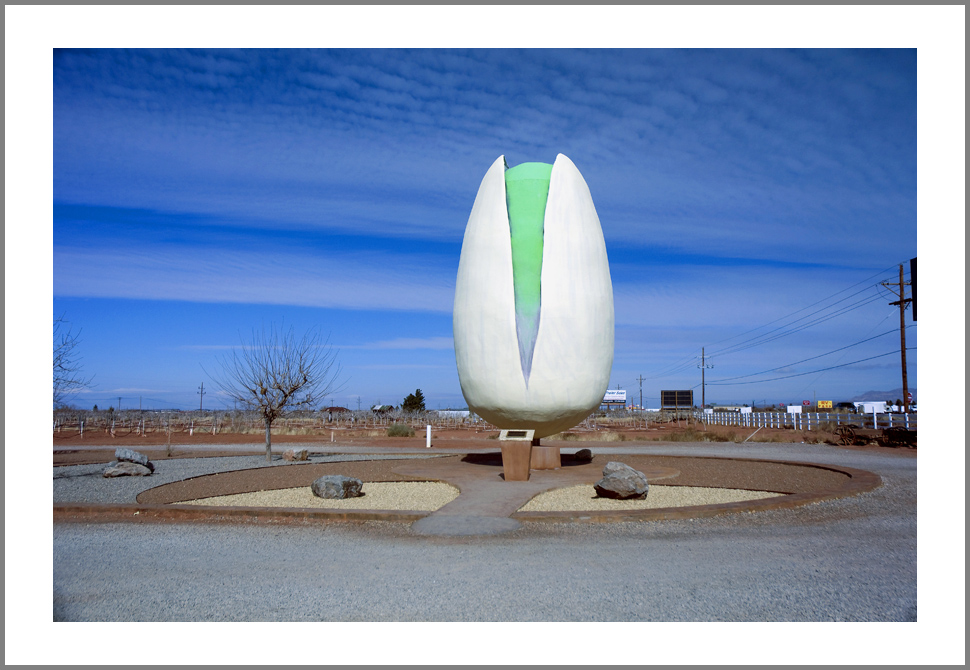
Just got a very welcome announcement from a Border Blog viewer. He pointed out that the above image is a representation of a pistachio not a pecan.
Correct!
We don’t have much of a defense, but really, when this was posted on April 24, your Border Blog photographer, Bruce Berman, wasn’t much Bruce Berman either. That’s what happens when one “does what one has got to do as opposed to doing what you do.”
We at Border Blog are pleased to announce that the real Bruce Berman is back, on the border, three blocks from the bridge, in his decaying ruin, tape -metaphorically- over his mouth, no longer talking about photography but living his life, and making images that, hopefully, will do, as we wrote almost a decade ago, stating our intention to (see the “About” tab above), “…cover the news, opinions and culture of the 2000 mile border of Mexico and the United States, concentrating on the epicenter of El Paso and Juarez. The Border Blog is not meant to be a news source as much as it is meant to be a news ‘feel’.”
Thank you MB and thank you Bruce (but tsk tsk on your caption!).
-The Editors
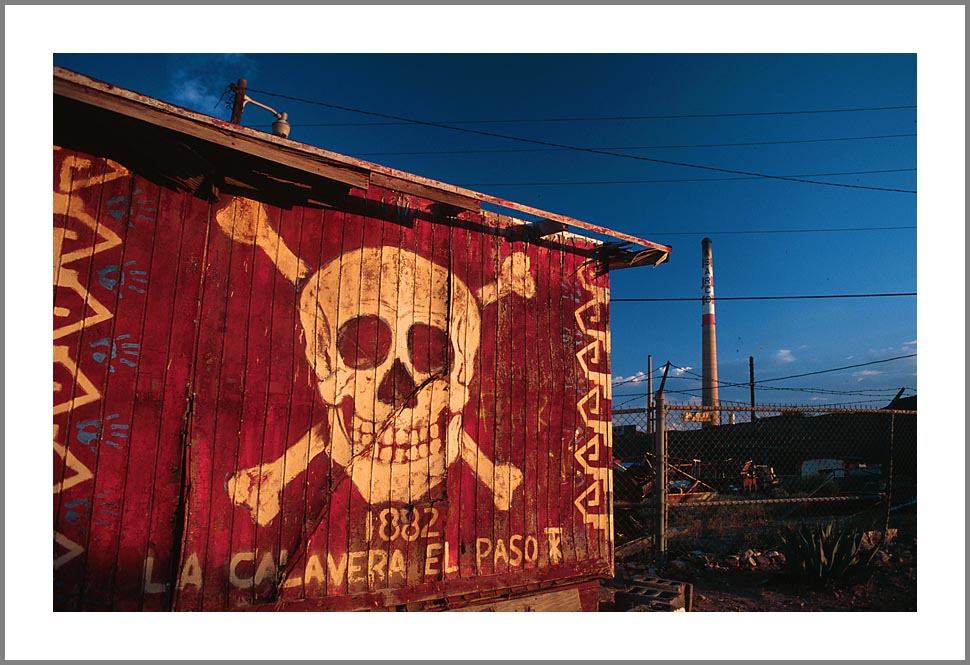
A Dear John Letter to ASARCO
by Bruce Berman
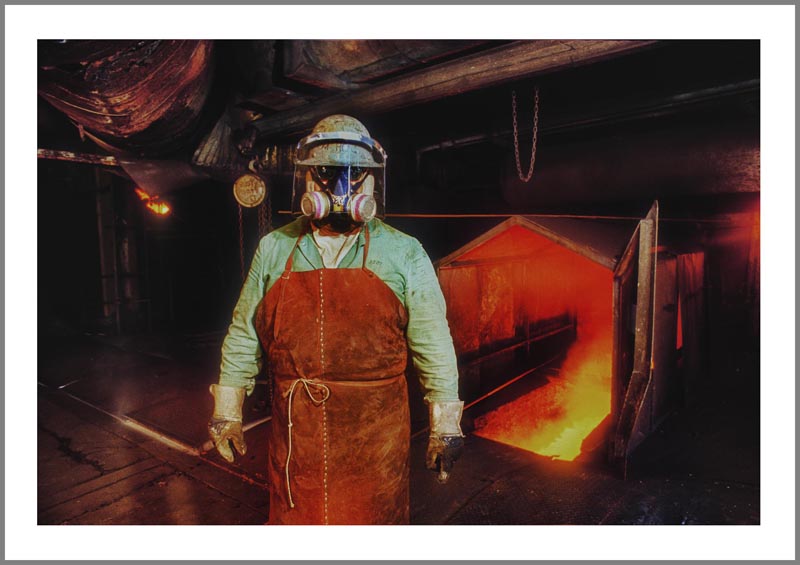
Au revoir ASARCO. You were the spine of the border, a big giant dong sticking up out of the river, pouring flames and sulfur, lead and smoke. The town grew up around you, fed off of you, then outlived you. You looked down on battles and traffic, always with the bifocals of looking at two countries at once. Looking east to El Paso, you looked down on the dusty foothills of the Franklins that became Kern Place and Mesa Hills, the sheik and elite (in its own mind). On the other, looking west, down into the dust and turbulence of Juarez, you looked down onto Colonia Felipe Angeles, which, too was foothills, that became a shanty town which became a barrio which became (shhhh..not quite yet) a path to a port of entry into New Mexico. What a vantage point you have had. When I first saw you I stood up straight, saluted and said, Wow, yes sir!
I dug you from the gitgo, had the pleasure of working inside you, being constantly re-awakened by you, of working inside you near those flames with the weather outside 105 degrees, feeling the comradie of your workers, the satisfaction of being inside something that wild and crazy and productive, a caldron of energy and raw power.
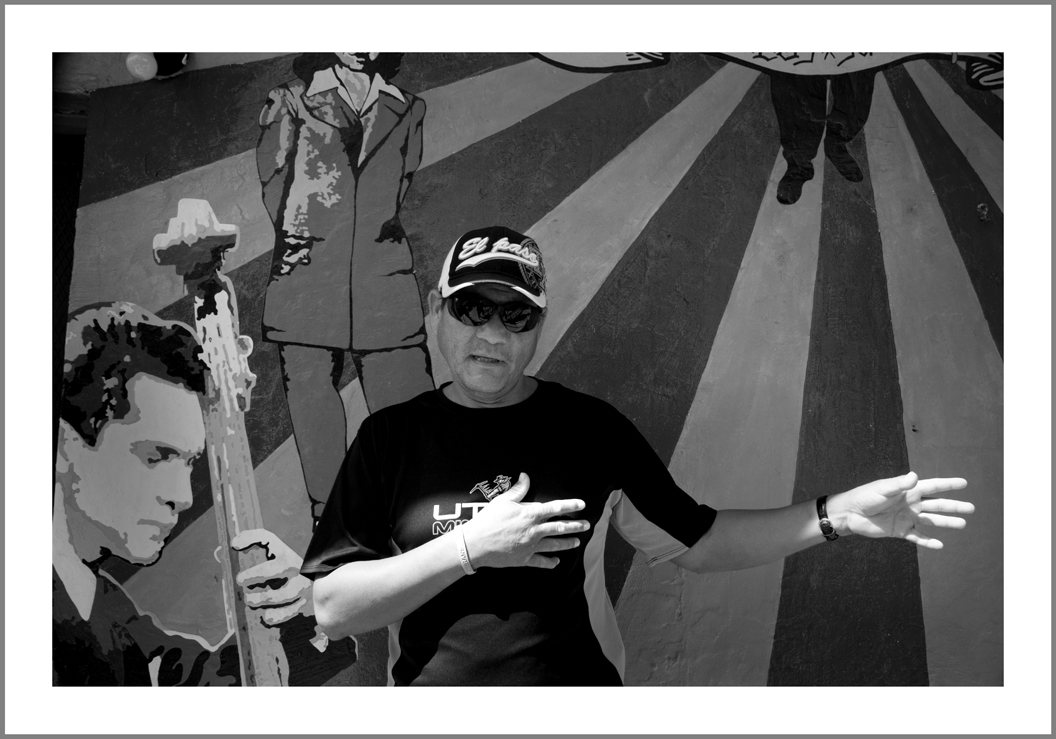
Photo and Text by Bruce Berman
Man from Anthony, New Mexico, describing his younger days in the Segundo barrio.
The Segundo barrio is El Paso’s most historic neighborhood, hugging the border with Juarez, Mexico and architecturally intact from the 1880’s “railroad boom,” that brought fired brick architecture and “Chicago Brick (which is atypical red).” Some adobe structures go back to the early 19th century. This part of the city has had human habitation for thousands of years. Spanish travelers began European settlement at this place in the Rio Grande/Rio Bravo in the mid 1600’s.
The real significance of the Segundo barrio, however, is the Latino community and it is significant. The barrio, historically, was the first “stop” on the journey north to “El Norte,” whether it was a matter of days for rest or for a generation of orientation. Many people in El Paso trace their roots to family who lived in El Segundo barrio in their first years in the United States.
FOR CAFÉ TACUBA VIDEO (and the rest of this article):
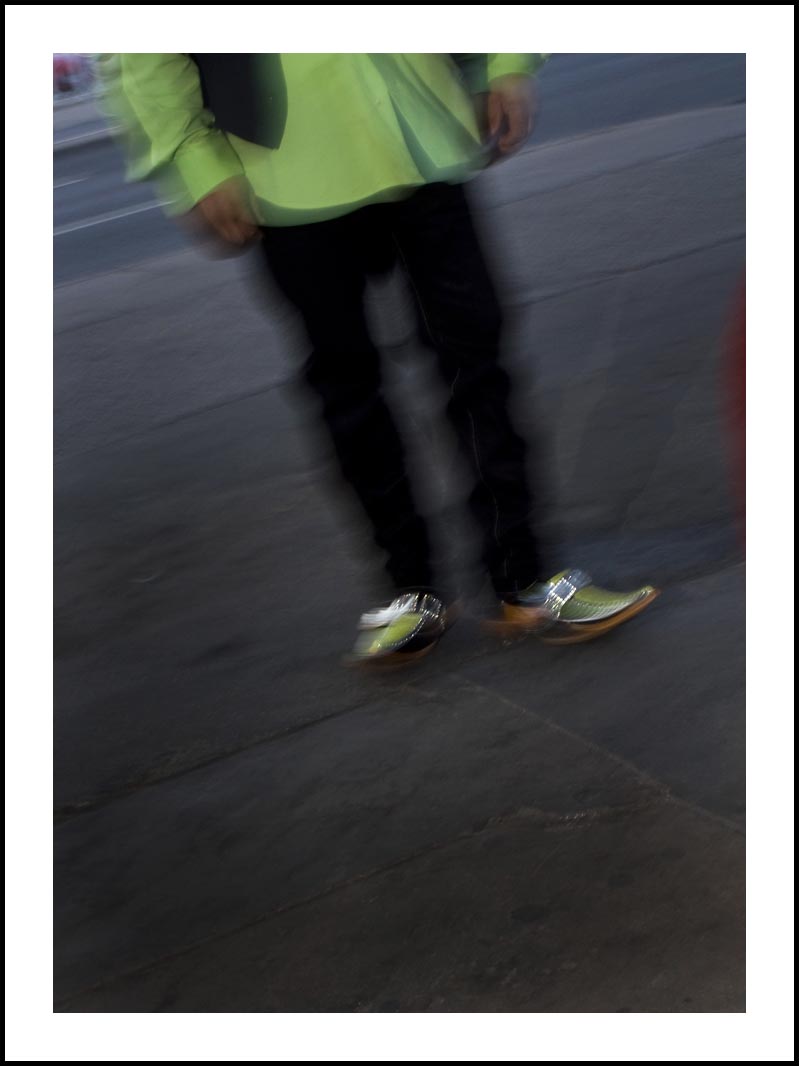
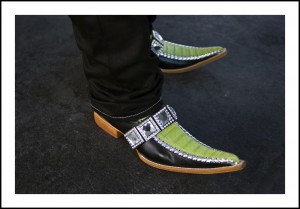
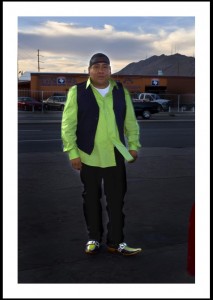
El Paso –Six blocks to the border. There are diamonds. Well, they ought to be diamonds. He says they cost $250. I believe him. Sunday drive. Family in the Dodge. Stylin’ on Paisano Street by Bowie (Boooie). If you know El Paso you know the references. If you don’t it wouldn’t matter. Chuco street.
One of the riddles of photography for me is that every once in awhile there is an image that must be in color. Most everything I see and shoot is in B/W, but every once in awhile…
This dude is in color.
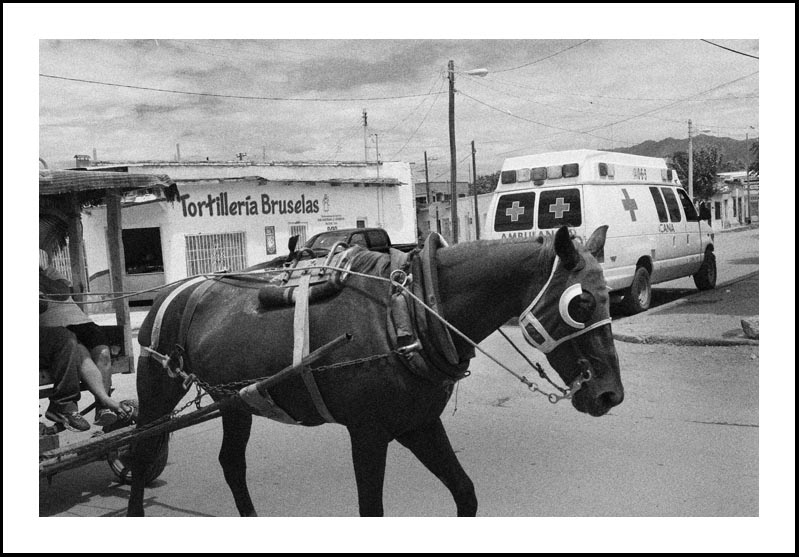
JUAREZ, Mexico – Juarez still stands. It is still Juarez. It is a city of my heart. I am not alone. It is insane what has happened in Juarez. There is no reference or metaphor: it just stinks. I walk the streets and there are “tastes,” of the old city. The “new city,” the one of Malls and chrome and green eco-glass, the nightclubs and shiny new cars has disappeared more than the old city has.
This might say something about what the condition of the city was before “The Troubles.”
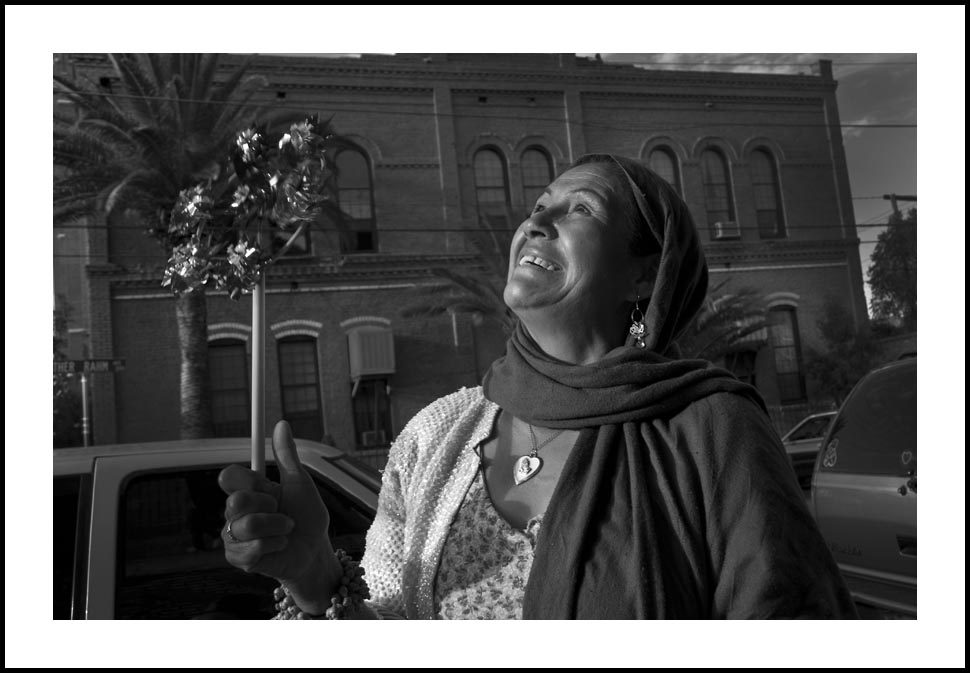
EL PASO –Angelica Alvarez. A true believer. A believer in her faith. A believer in a better day. A believer in joy.
I noticed her as she worked her way down the street, engaging every person that she encountered, leaving each person she talked with a smile on their face, enthusiastically waving goodbye to her, they no longer strangers.
I followed her.
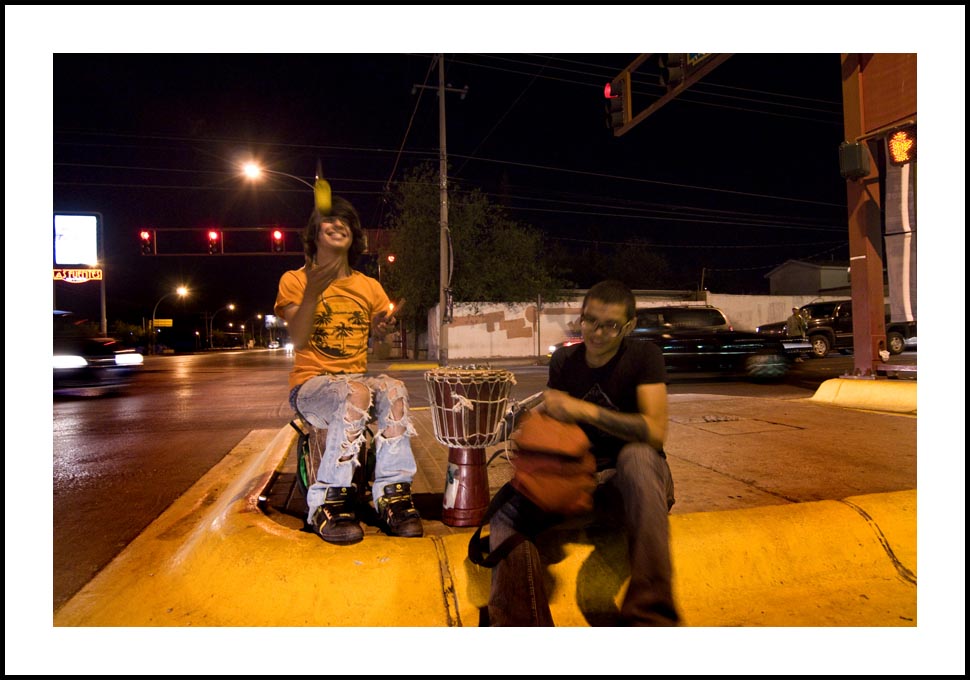
Pictures?
More pictures of dead bodies in the streets of Juárez?
Hard to want to do. I’m not visiting. I live here. It’s better when you have to get the images for your boss/editor and then high-tail it to the airport.
But, I’m not working for a daily paper anymore.
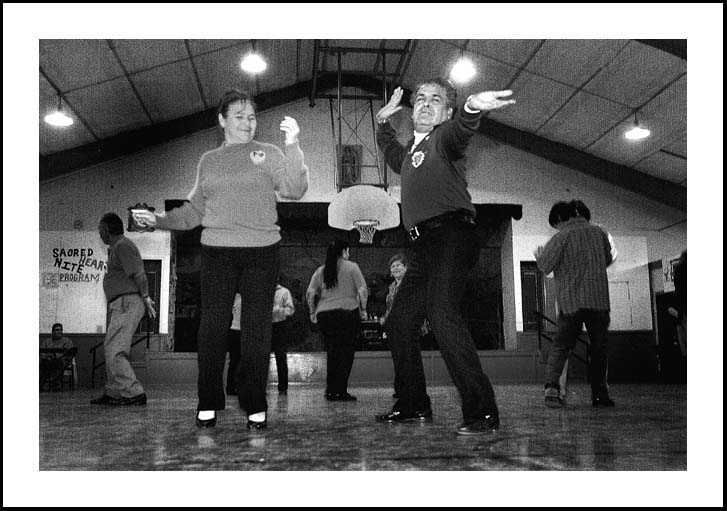
Sagrado Corazon gym. Sunday dance.
Kick it.
Kick it hombre!
Golpelo, vato viejo (no muy)!
Joy always seems to be somewhere near this gym. The ‘hood is really tattered now. Anything near the border is tattered or about to be.
But ya gotta dance, yeah?
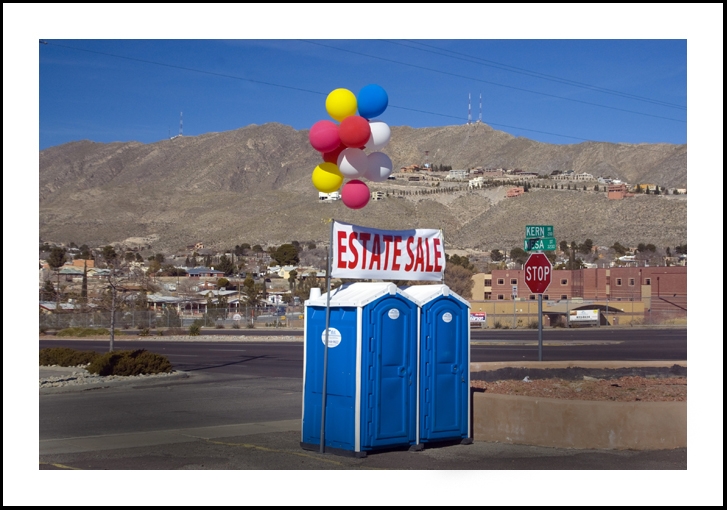
From the movie The Border:
Marcy (Valerie Perrine) : (Showing her Border Patrol husband brochures about El Paso, trying to talk him into moving there, at their breakfast table, in Los Angeles) Honey sometimes you gotta dream.
Charlie Smith (Jack Nicholson) : (Pausing, furrowing his now signature brow) I never dreamed no El Paso.
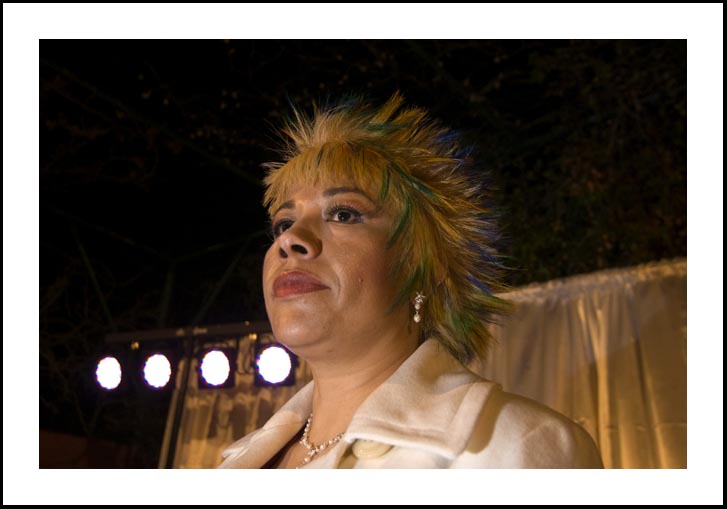
Candy? Flowers? Lingerie?
Furgidaboutit!
Beauty!
Big day on the border. Everywhere now. Billions in tooth decay. Billions in flowers grown in eco-destroying third world corporate gardens.
Bah humbug (or whatever malapropism you say on Valentin’s Day)!
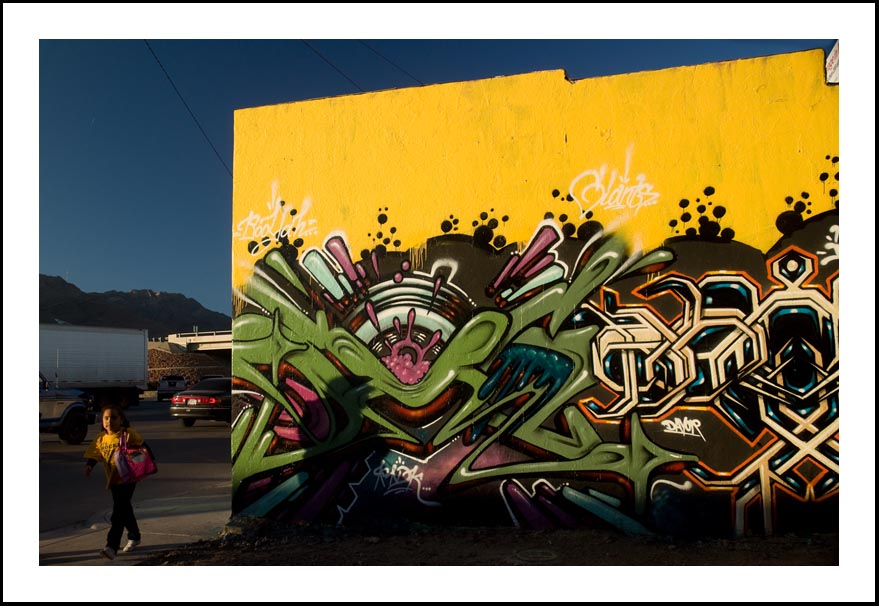
Four blocks to the bridge, to the border.
Lots of foot traffic. It comes and it goes, north then south.
The neighborhood is changing as the Medical Center becomes a reality, but it’s going to be hard to erase what the neighborhood is.
This mural, sneaked in on the side of a little building on a main street, in an alley, screams, We are alive!
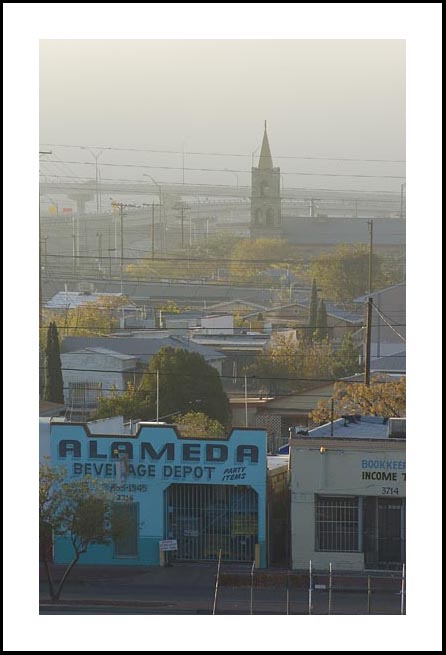
The view south, across Alameda street, across the Chamizal, three blocks beyond, across the bridge, into Juarez, into Chihuahua, into Mexico, beyond.
Usually the view is razor sharp. The last few days have fuzzed things up: snow, rain, and, now, this morning, fog.
Been looking south across this razor sharp landscape for a long time and, finally, a little fuzz feels right. There will be no clarity. Better people than I have written and viewed this border, came up with “clarifications,” and “explanations,” and “revelations,” and yet it goes on, untamed, inexplicable, roque.
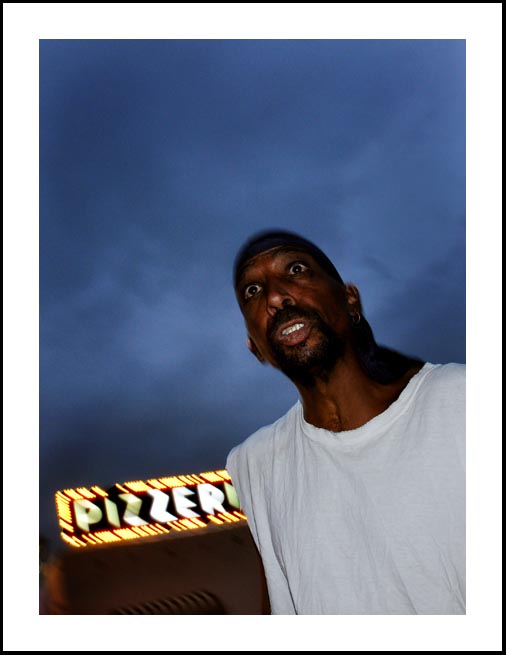
Been thinking about this guy and borders and the idea of the Big Picture versus the small picture ever since I made it (the photo) this summer, on an almost rainy night, in the northeast section of town, out by the military base.
John Hughes.
Angry. Joyous. Funny. Dangerous. Sweet. Full of love, hate and ambivalence. Boozed up, half mad, half brilliant.
“I am free,” he shouts at the night. “I am free and I am in hell.”
I ask him if he ever goes across the border?
“I am borderless,”he replies, “aren’t you?” He shakes his hand and does a twirl, almost stepping into busy Saturday night traffic.
He does a little dance and steps so close to the edge of the curb that I go to grab him but he spins back onto the sidewalk and does a very theatrical bow. He is a tight rope walker and it looks like he has done this toe dance forever.
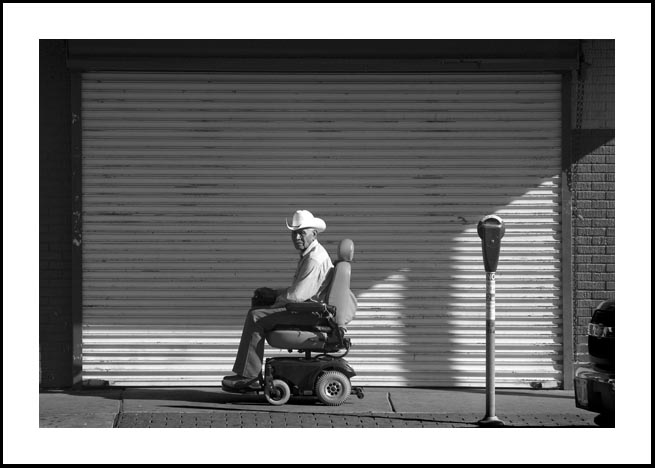
There are a lot of viejos in the Sagundo barrio. They get around.
There are a lot of kids too.
Like it always was but just fewer. It’s the heart of this isolated town.
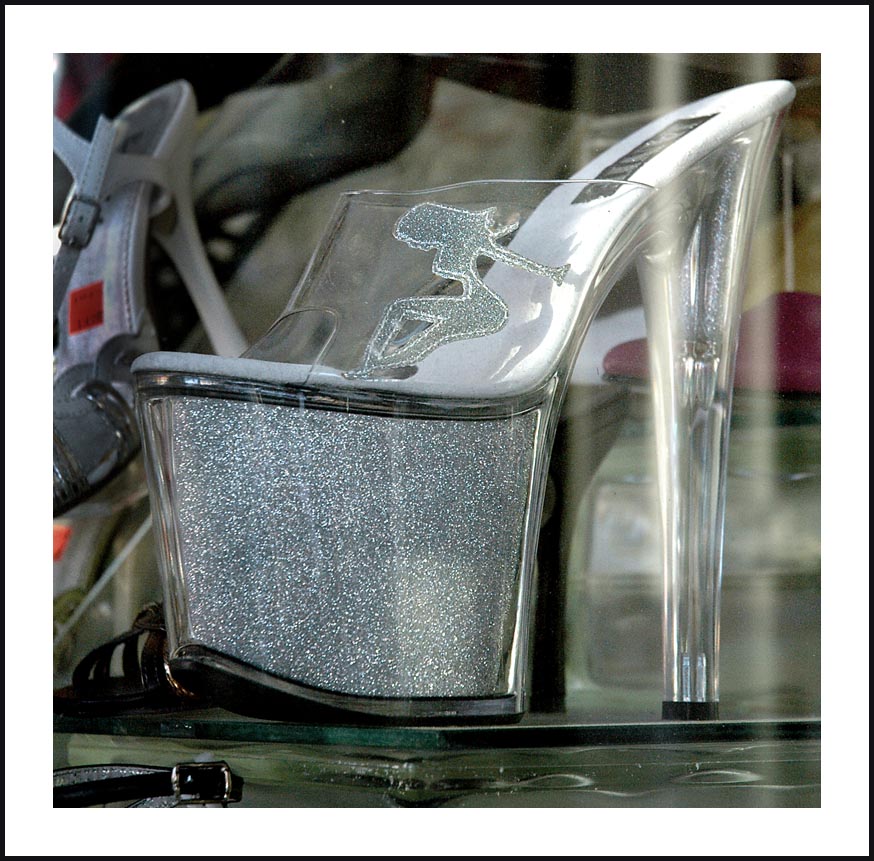
It ain’t all war and drugs and deals.
Or is it?
Right here, in the midst of it all is…this!
Who made this? Chinese hands? Sweat shop Haitian hands? Don’t tell me North Carolina hands! They did wingtips, right?
Who will end up with this radical pump? Where will they wear it (I think I can imagine)? Is there pain and despair there, or a happy night? Baile, baile. I hope. Will this end up on the other side of the border or is there a place, close by, that will be dazzled by the wearer of this shrine?
Is this the scariest thing I have ever seen or the funniest and why is it this that provokes my thoughts and not the library or some archive or gallery? Why is it this that reminds me of those who toil without options of what is toiled at? Is everything always going to bring my thoughts to the Cartel, to class disparities, to the haves and the have nots, to the black magic of the border? Is that my fate: to see the most outrageous shoe in the history of my life and I can only think of slavery, not aesthetics?
Can I just let it slide? That seems like a long time ago.
Ah, all this in la pumpa monumental.
I smile. I gather the image. I harness my moment. What else can you do? We’re all stumbling around, teetering on some spiky platform or another. Making it look good. We toil at what we toil at, we dance with the partners we’re given, we all try to slick it up. What else can you do?
Otra vez, calle El Paso…estas el mejor!
I have loved you for a long time.