Search results
9 results found.

On The Edge of the Edge – The U.S. – Mexico Border
9 results found.
All photographs are ©FrankOscarLarsen2015
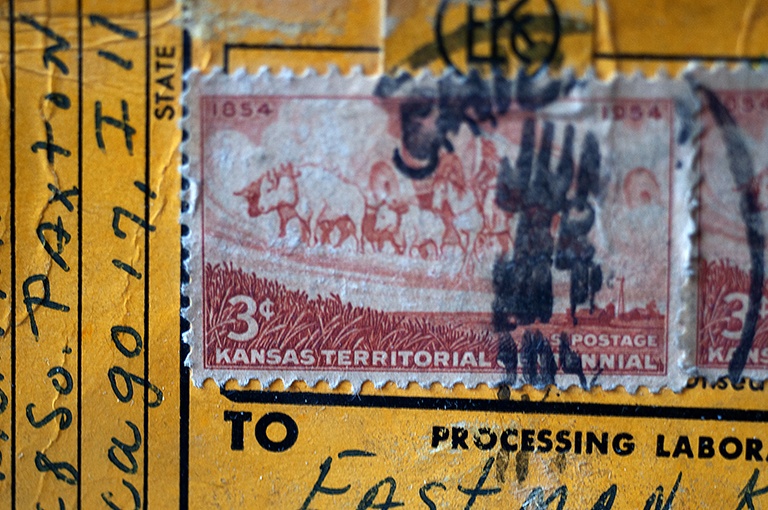
Cancellation #93, Mom’s Kodak film, Chicago, 1950s
I once did an entire series of photographs called “Cancellations.”
It started because one day I was looking at a stack of shipping boxes of my photographs that I had sent to various galleries and museums (pre Internet) that had been summarily rejected. Thanks. No thanks, return to sender. There were a lot of stamps on those heavy boxes. The post office cancellations were ruthless, slashing, colorful. It’s like the post office knew I was unworthy, as well. I half jokingly wondered if the galleries hadn’t done it themselves.
I got lucky here and there, exhibited them for awhile. Dallas. Houston. Cologne, Germany. The art world thought they had found a new star. I knew I was a fraud.
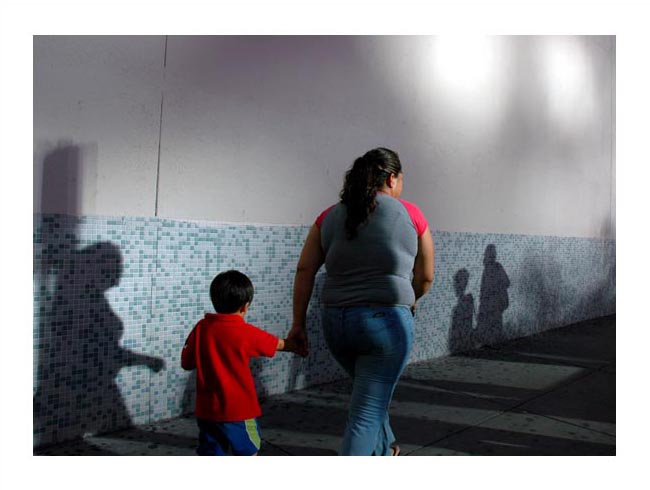
Opinion/Observation
by Co-Editor Bruce Berman
___________________
I drive my old routes. Camera on the passenger seat or my lap. As always, these days it usually stays there, untouched. There are things along the way that spark memories. Object that aren’t there anymore. Gorgeous commercial signs constructed by craftsmen in the 1950s and 60s (not the least of which from the Jimenez Sign Company) were carted off to other cities that were twenty years ahead of El Paso in their bourgeoisie ambitions.You can drink under some of El Paso’s “Motel, Vacancies,” signs in various bars from Austin to Houston to Baton Rouge. There’s a withering away now, aging and weathered, but mostly not endearing anymore, not worth stopping for (to make images). There came a year, a month, a day when the treasures of El Paso were either gone, carted off or just left to rot.
There are whole swaths of this incredible and authentic city that are gone, at least for the long gaze of a photograph: Alameda. El Centro (downtown). Segundo is shrinking fast, bordered by El Paso Street on the west (with nasty tentacles of them all over it) and Cotton on the far east, with old residents living out their days, youth getting out fast and them with their bulging eyes all over it. Off of Delta there are condominiums and some revamped industrial buildings, residents living an almost urban lifestyle (sans humanity). Even the Gay Bars have fled, a sure sign of urban renewal/removal.
It’s not my job to do anything about any of this. My job, as I saw it, at the beginning, in 1980, was to give face to a face that was not known and I have tried. As The Grid lays out its future in the city with two hearts, it’s clear to me that my mission isn’t to pick sides in land rights, power exchanges, or to watch -or judge- the inevitable blandification. But blandification has come. Oh happy day. Some loudly exhale and go, finally! The city is becoming presentable to visitors again. It’s cleaner. It’s newer. There’s baseball. Soccer is coming (watch out Chamizal! The final blow that started in the mid 1960s is finally here). There are restaurants with the preface Le with Foo Fo thing-a-ma-jig dishes with little portions of things that look like they squiggle -vegetables- on top of things it’d be hard to identify below. Fancy. Plates of Foo Foo. There are young people downtown again, well, the kind of young people that look like they’d also be comfortable up in Kern Place on Cincinnati and the upper Westside.
Finally, there’s a Starbucks downtown near the Plaza and the Westin. The kids from the ‘hood can serve the hipsters that come in from outer Zaragosa Road and beyond.
Boring? Not to everyone and I wish them the best. I am not part of this. I left this scene in three other places I lived before this very long stretch here. It’s the same message: you’re in the gentry or you’re equitied out of the gentry.
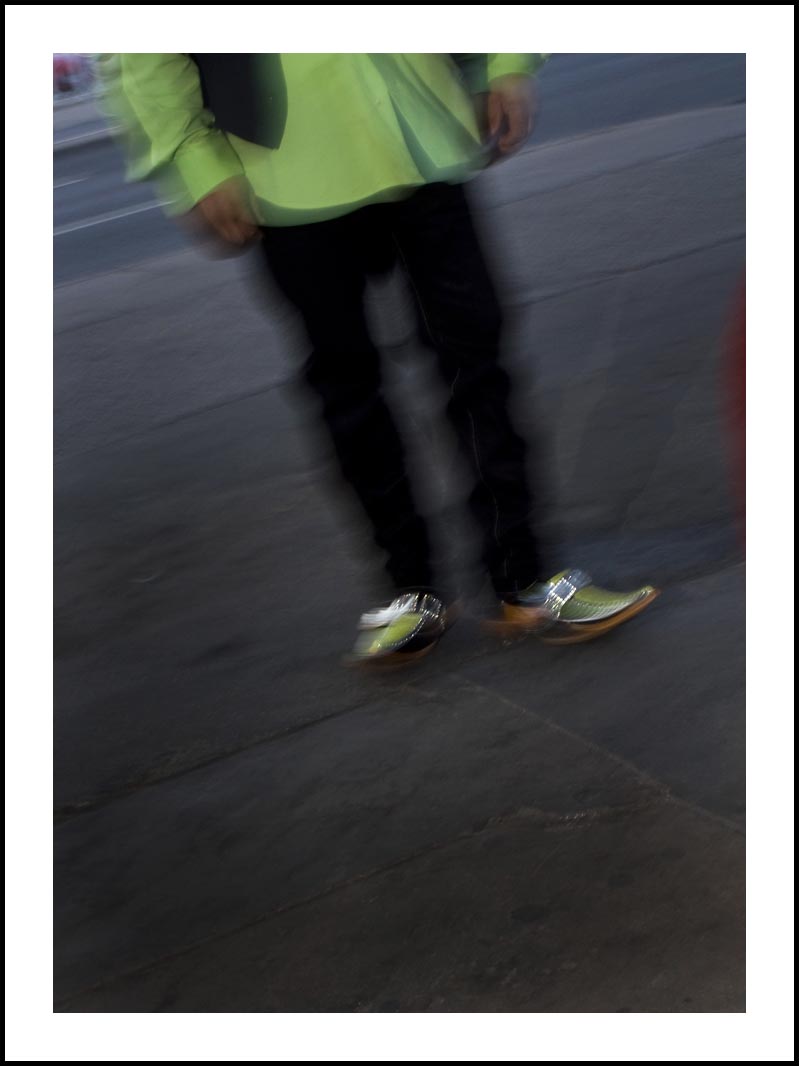
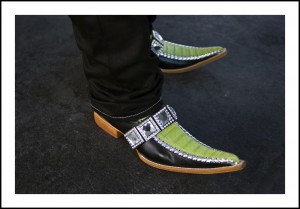
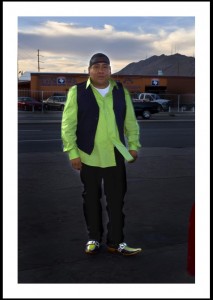
El Paso –Six blocks to the border. There are diamonds. Well, they ought to be diamonds. He says they cost $250. I believe him. Sunday drive. Family in the Dodge. Stylin’ on Paisano Street by Bowie (Boooie). If you know El Paso you know the references. If you don’t it wouldn’t matter. Chuco street.
One of the riddles of photography for me is that every once in awhile there is an image that must be in color. Most everything I see and shoot is in B/W, but every once in awhile…
This dude is in color.
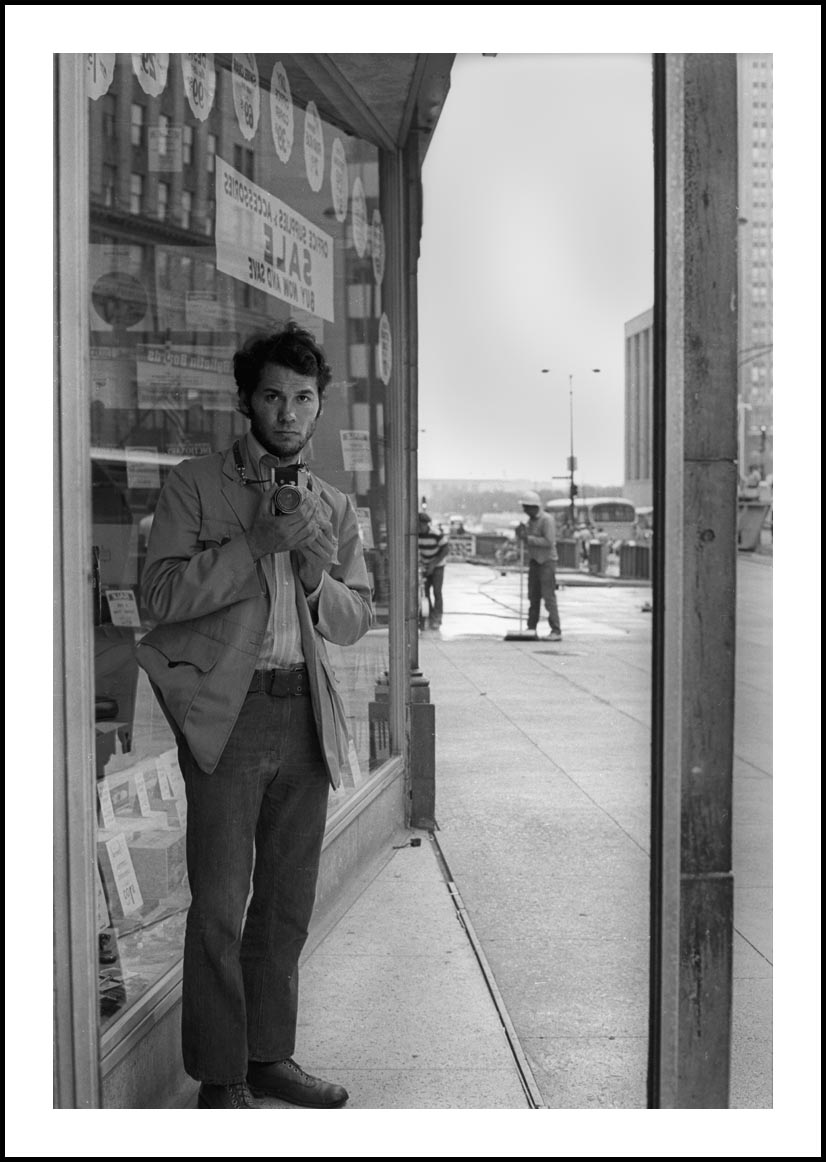
Garry Winogrand. Off kilter. Off beat. And right on in capturing the milliseconds of the oblique.
Watch this video and think about Garry lassoing the non-monumental. He was a wild puppy and full of life. Just enjoy the fun.
A memoir: Meeting Garry Winogrand
by Bruce Berman
Garry was a photographer and a winner of prizes: three Guggenheim Fellowship Awards (1964, 1969, and 1979) and a National Endowment of the Arts Award in 1979. He was a street guy and he was, most of all, a New Yorker. His photos reek “NYC.” He was hugely famous and revered in the 1970s and 80s.
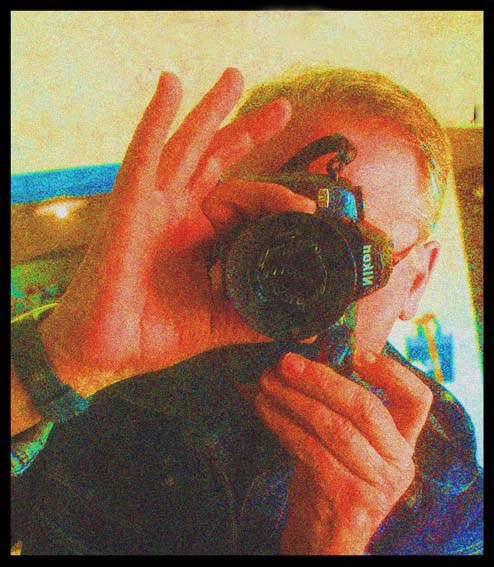
About Bruce Berman
Bruce Berman has been a professional photographer for over four decades. He works in what some have called, “The Concerned Photographer,” style of photography, but brings a poets vibe to his images. His initial documentary projects were in Chicago where he photographed Appalachian migrants to the big city, Black Panthers during the tumultuous 1960’s and the gritty street life of Chicago in its Rust Belt years.
His main work for the past forty years has concentrated on the United States/Mexico border, particularly the narrow stretch of land that encompasses El Paso, Texas and Juarez, Mexico. He also “plows” the southern New Mexico landscape, its people and the vast mysterious lands of West Texas.
After coming back from one of his earliest forays on Alameda Street on El Paso’ south side, in 1980, Berman wrote in his journal, “…I have seen a new world. It is both physical fact and mythical idea. It is a place with a line drawn through it and on each side of that line there are metaphoric mirrors that are reflecting back at each other, perhaps distorting each other, perhaps magnifying each other. It is the US/Mexican border. I will make my stand here. I will try to ‘give face,’ to this place so others can know it, perhaps, even, so those who live in it will know it more deeply.”
The aggregate result of that effort resides in two main bodies of work: The Border Project: 1985-2007, and Juárez: Cartel War Years (2007-2011) .
Additionally -concurrently- he is a chronicler of the disappearing lands beyond cities. He calls this series The Funklands, and notes, “Nothing is just laying around anymore. It’s scooped up, trucked away, rebuilt and becomes a mega buck treasure. My treasure has been the texture of the land and the stuff laying around that attests to who was on that land before… well.. before the homogenization of America.”
Berman lives and works deep in the borderlands of El Paso and Juárez, three blocks from the international bridge that connects Juarez and El Paso, surrounded by and isolated in the the vast lands of West Texas and northern Chihuahua. He refers to this as the “City-State of No Man’s Land.”
Berman continues to cover his “beat,” for major publications throughout the world and for his own book publishing enterprise. The Border Blog Press. His recent book, Walking Juárez is a compilation of photographs and stories covering the years 1975-2018.
Since 2008, Berman has added “Professor” to his name. He now teaches photojournalism at New Mexico State University (NMSU), 50 miles north of the El Paso/ Juárez ports of entry, in Las Cruces, NM. His teaching concentration is on Documentary Photojournalism and multimedia reporting. He still does occasional assignments and personal documentary work but spends equal time “Passing the torch,” he says.
Lately Berman has concentrated on doing books: Walking Juárez, 2017, Cutting the wire, 2019 and his newest, BACKLAND, 2022.
Many of his students don’t know about the border too much, but for the most part are of it. The G Generation, he says, “… are the hope of photojournalism, and maybe the world.”
He thinks working with them is his best project ever.
About the Website
The Border Blog covers the news, opinions and culture of the 2000 mile border of Mexico and the United States, concentrating on the epicenter of El Paso and Juarez. The Border Blog is not meant to be a news source as much as it is meant to be a news “feel.”
Another “border,” of interest to Berman is less obvious, the border between The Grid (his descriptor) and and those on the margins, unwilling or unable to keep up with “development,” and “progress.”
The site is a collaborative project. Besides Bruce Berman, who acts as editor and photographer and sometimes writer, the staff includes writer and painter, Juarez native and resident, Nathan Zarate, and, Beatriz Andino Zamora, a poet and writer from Zacatecas, Mexico. Zarate and Zamora post occasional articles concerning the politics and history of Mexico, in general and La Frontera, in particular. The site is always appreciative of the creative inspiration, brilliant chutzpah and deep goodwill -as well as extensive Web skills- of Manuel Rivera, a fronterizo “to the bone.”
Contributions to the site are welcome. Diverse viewpoints will be cherished. The site’s point of view and orientation will be no mystery to its readers, however, there will always be plenty of room and appreciation for other voices as long as they are informed, well articulated and sincere and fueled by passion tempered by reason.
PHOTO OF THE WEEK: April 11-18, 2008
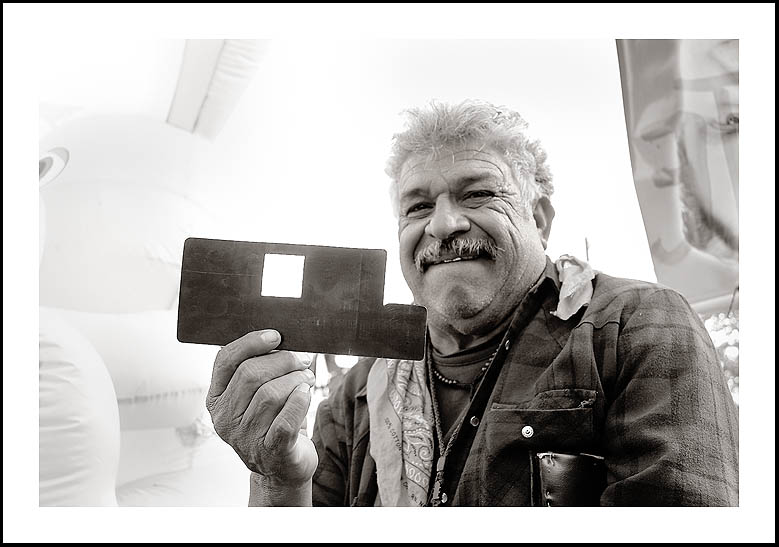
Polaroid Corporation announced in early February that they no longer will make Polaroid instant cameras or film.
This announcement, world wide was greeted, mostly, by a collective shrug of the shoulders and a “ho-hum.”
For Juarez street photographers the news was immediately alarming, living-threatening, and was a call to action for a new learning curve to transition to digital photography.
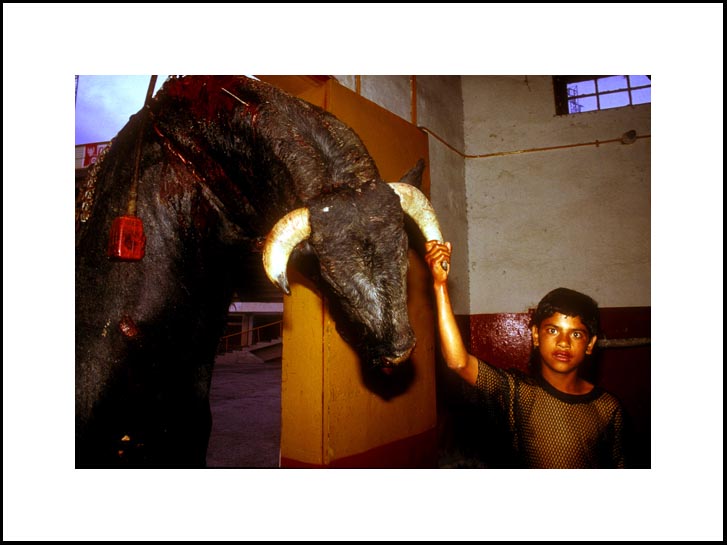
I’m a little weary of border politics, for now.
I return to the streets and hope the disorder of life gives me shape and form.
Politics and News seem to work on a linear arc.
Facts. Information. Plenty to tell. Endless detail and weight and nuance. Narrative is interesting but one of the things I’ve always liked about doing photography is the occasional punch in the gut you get from just being somewhere (often where you shouldn’t be).
Photography can work as a fact machine, but when it doesn’t and it’s just image, impression, reaction, light, when there is more than the sum of the parts, I like it the most.
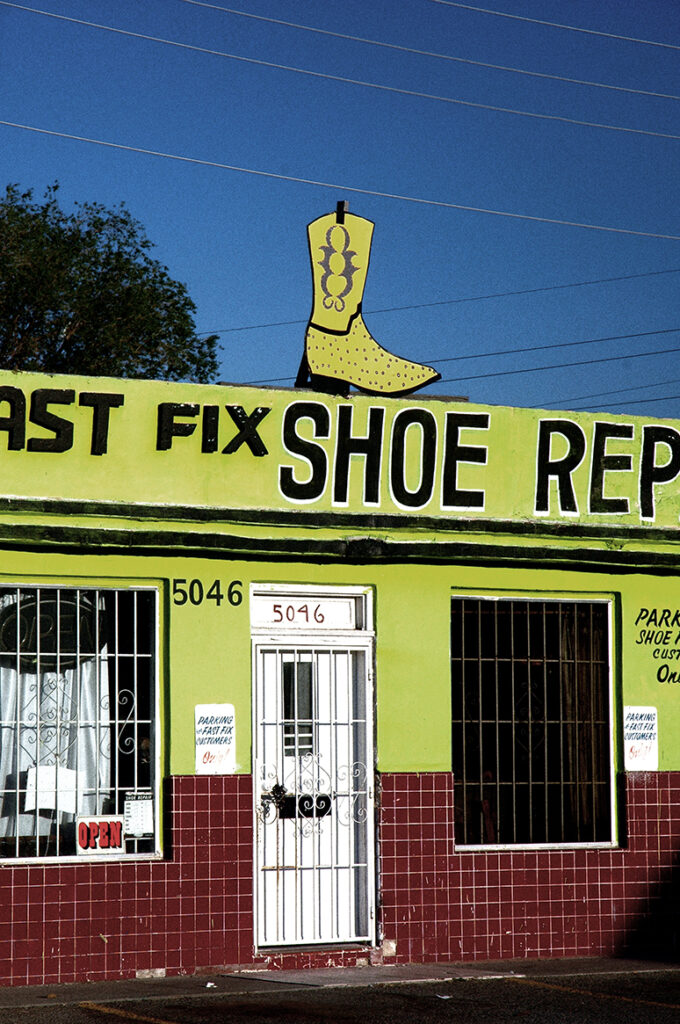
Boot/Shoe, El Paso, Texas, Highway 60/182 (Alameda Street), 2006
Text and Photography by Bruce Berman
Mexican presidential candidate Andres Manuel Lopez Obrador has called for a ballot-by-ballot review of Sunday’s presidential vote. He says the stability of the country is at stake. Mexico’s Federal Electoral Institute Wednesday began reviewing the totals from polling stations to determine whether Obrador’s rival, Felipe Calderon, really won the election Sunday. A preliminary count showed him ahead by only one percentage point. Both candidates declared victory Sunday night.