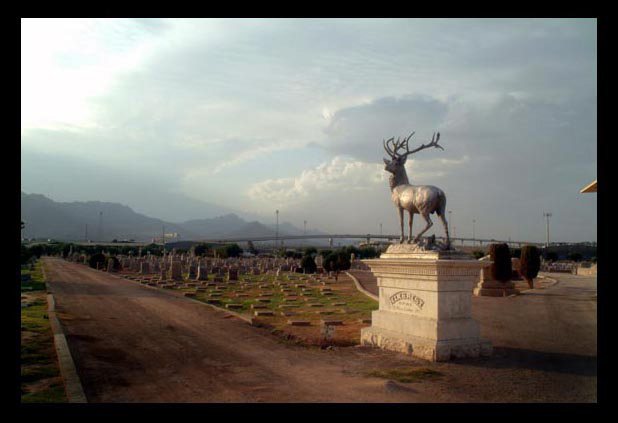
June 2006, Evergreen Cemetery, El Paso, Texas

On The Edge of the Edge – The U.S. – Mexico Border
June 2006, Evergreen Cemetery, El Paso, Texas
MexOnline.com – Mexican Revolution of 1910
The Border(PBS) | About the Show
Produced by Matthew Sneddon, KNME-TV, Albuquerque, New Mexico 
The economies of Juarez, Mexico and its sister city, El Paso, Texas are driven by a system of assembly plants known as maquiladoras. There are more than 600 maquiladoras in Juarez, two-thirds of them owned by U.S. companies. Since the first maquiladora was built in Juarez in 1976, the population of the city has increased nearly five-fold to more than 1.25 million, making it the largest Mexican city on the border. The Rio Grande fuels Juarez and El Paso’s water supply.
However, the more than 10 million people who live in these desert communities have begun to exhaust the Rio Grande’s capacity to support them.
This segment focuses on one Rancho Anapra family faced with the realities of living in a desert community with no running water. It examines the factors that contributed to growth of this particular border region: the Rio Grande, the maquiladoras and the promise of a better life.
 Roberto Martinez is the former director of the U.S./Mexico Border Program. A lifelong Chicano activist, he has spent 30 years monitoring human rights in the San Diego/Tijuana area. In 1992, he was honored as an Intermational Human Rights Monitor by Human Rights Watch, the first U.S. citizen to be honored in such a way.The following essay, published here as a call for a humane U.S. immigration policy, was written as the introduction for the American Friends Service Committee 2003 human rights report.


Shouldn’t this river unite?

Blogmeister’s Note: This is a piece written by a friend of The Border Blog. He is a Mexican National, a university student who attends the university in El Paso and a good guy. Especially, if one is looking for an insight, note the second to last paragraph and multiple it by the millions.
The BB welcomes all viewpoints, especially this one . Thank you, Javier :
Why I Voted For Felipe Calderon
I was listening to my aunt Lupe while we were driving down Periferico
Sur highway about a month ago in Mexico City. She told me about Andres Manuel Lopez Obrador (editor:AMLO), the presidential candidate (at the time), and how he managed to obtain the votes of lots of people in Mexico City by offering social assistance to senior (over 65) people and single moms while he was the city’s mayor.
From Cheech Marin’s Chicano Visions: American Painters On The Verge touring exhibit.
Next Stop: de Young Museum
San Francisco
July 22-October 22

(From the staff, management and hangers on of the Border-Blog: Gracias Cheech for just being cool)
The Mexican Election: More Collateral Basura
I ran into a friend at the gym of the local university. He is from Mexico’s interior ( but the north). Smart guy, a brother. The university sits smack dab on the border and looks across to Juarez from El Paso. The university has many Mexican nationals mostly from Juarez but with a significant number of citizens from the interior, a majority of Mexican Americans and a smattering of Anglos. Like many things on the Border, it is physically the United States and pragmatically in Mexico (language, culture, food).
I ask him if he voted in the recent election.
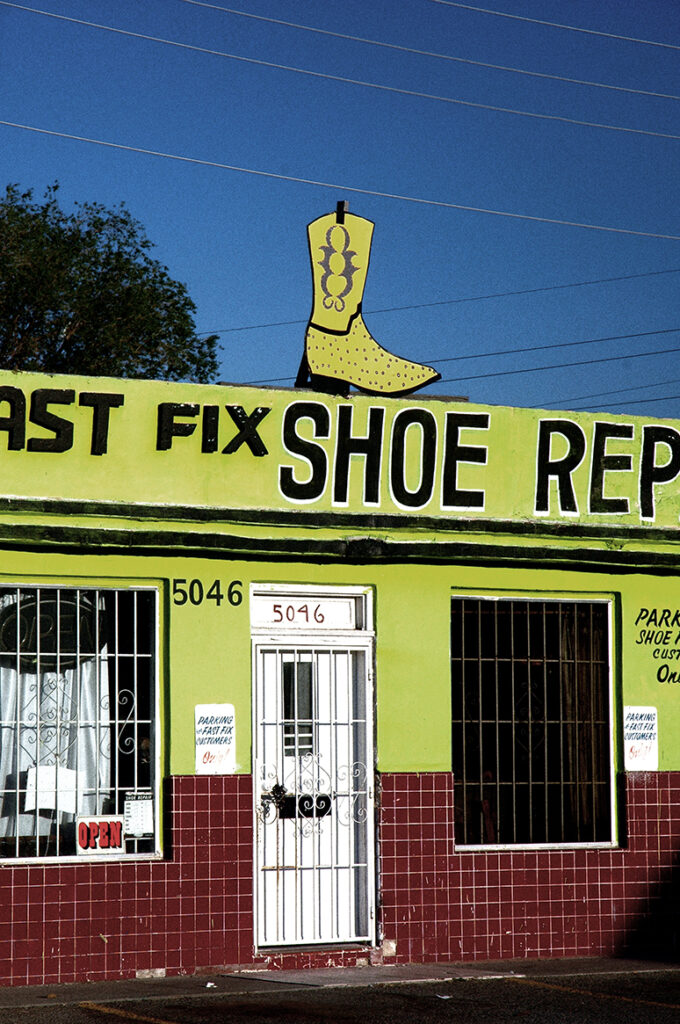
Boot/Shoe, El Paso, Texas, Highway 60/182 (Alameda Street), 2006
Text and Photography by Bruce Berman
Mexican presidential candidate Andres Manuel Lopez Obrador has called for a ballot-by-ballot review of Sunday’s presidential vote. He says the stability of the country is at stake. Mexico’s Federal Electoral Institute Wednesday began reviewing the totals from polling stations to determine whether Obrador’s rival, Felipe Calderon, really won the election Sunday. A preliminary count showed him ahead by only one percentage point. Both candidates declared victory Sunday night.
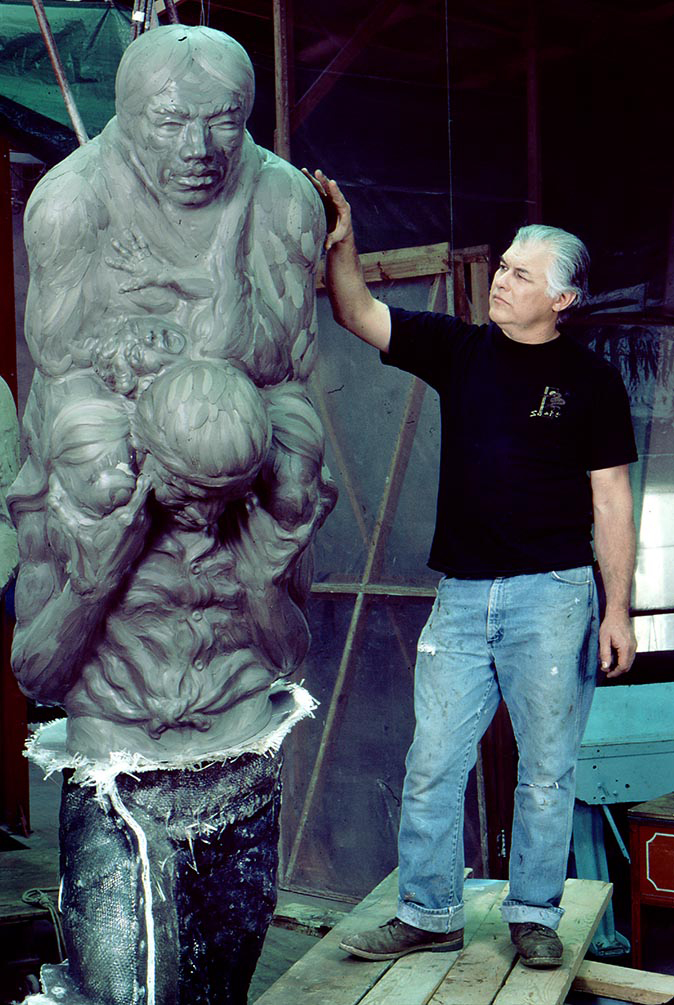
Luis Jimenez, Hondo, New Mexico, 2001
Born: July 30, 1940, El Paso, TX / Died: June 13, 2006, Hondo, NM
The first time I met Luis, back in the seventies, he came into my apartment and seemed to fill the room. It was like no room was big enough for him.
He was that big of a g
Not physically, although he was that powerful.
Not spiritually, although he did have that aura of somebody who really sees the bigger picture.
He was just big. All of it. Life. Love. Art. Humor. Seriousness. Ambition. Regular guyness.
When I first met him, and I suspect this is what most people felt upon first encounter, I felt like my life was just a lot more complete than it had been a moment before.
If you wanted to be good at something, in my case it was to be a photographer- you knew he’d be encouraging for your dream.
He was a brother. A big brother. And like a lot of big brothers, he was larger than anyone could possibly be.
And, man, was he smart.
He said what mattered. He lived He cut the crap.
He made impossibly complex Art and made it look like you could buy it from a south side El Paso Body Shop. And the Art mattered. It was about something. It was about him and our culture and his culture and the idiocy of our system and about the flora and the fauna and intuition and magic and love and joy.


